
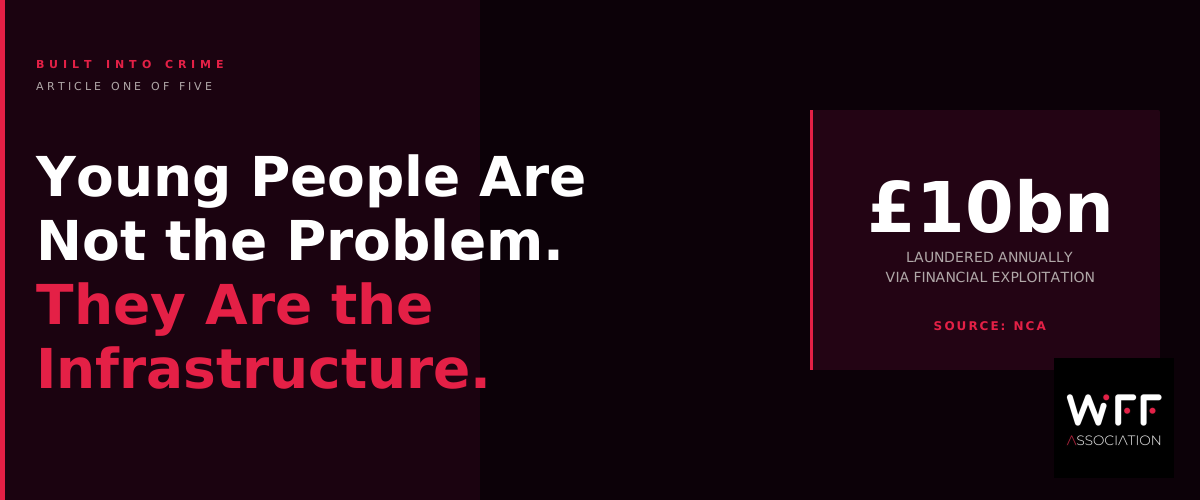
Young People Are Not the Problem. They Are the Infrastructure.

The UK has a financial crime problem it has not yet properly named.
It is not a new type of fraud. It is not a novel laundering technique. It is something more structural and, in many ways, more troubling: the systematic recruitment of children and young people as the operational infrastructure of organised criminal networks.
This is not peripheral to the work of anti-financial crime professionals. It sits at the centre of it. And the scale of what is happening demands the community’s full attention.
Over the coming weeks, we will be publishing five articles that together build a complete picture of this issue: what is happening, why young people are being targeted, where the system is falling short, what a genuinely different approach looks like, and what the anti-financial crime community can do about it. If you work in fraud prevention, compliance, financial intelligence, or policy, this series is for you.
The National Crime Agency estimates that over £10 billion is laundered via financial exploitation networks in the UK annually. Behind a meaningful proportion of that figure are young people, many still in school, college, or the early months of university, who have been recruited, groomed, and in some cases coerced into moving illicit funds through their bank accounts.
Research from Cifas found that more than one-fifth of adults in the UK thought this type of financial exploitation was legal. In 2024, the FCA reported that more than 225,000 individuals were identified as having been involved in financial exploitation, a 23% increase on the previous year. Government data has underlined the scale of the problem: 65% were under 30, with nearly a quarter aged under 21.
These are not figures about marginal or isolated incidents. They describe a sustained, deliberate, and growing strategy on the part of organised crime.
A note on terminology: from money mules to WUFE
The way we talk about financial exploitation matters. Historically, people whose bank accounts were used to move criminal funds were labelled as “money mules.” However, this term does not accurately reflect the experiences of young people who are drawn into criminal activity through grooming, pressure, manipulation, or misunderstanding.
To address this, the Home Office has updated the terminology to WUFE: Witting and Unwitting Financial Exploitation. This distinction is important for several reasons.
Unwitting involvement: many young people do not realise they are being exploited. They may think they are helping a friend or taking part in a harmless favour.
Witting involvement: some young people have partial awareness but may still be influenced by coercion, threats, emotional pressure, or financial vulnerability.
The term reduces stigma by moving away from language that labels young people as criminals, and instead recognises them as individuals at risk of exploitation. It supports safeguarding practice by focusing on the behaviour of exploiters rather than blame placed on young people, helping professionals respond in a trauma-informed way. It also provides greater clarity, better reflecting the wide range of tactics used by organised crime groups to recruit and exploit young people.
Throughout this series, we use WUFE and the language of financial exploitation in preference to the older terminology, in line with Home Office guidance and current safeguarding best practice.
The vulnerability context
Criminal networks do not operate randomly. They identify structural vulnerabilities and exploit them with precision. For young people in the UK, those vulnerabilities have rarely been more pronounced.
Youth unemployment for those aged 16 to 24 reached 16.1% in the final quarter of 2025, the highest level in over a decade, while nearly one million young people are not in education, employment, or training. Set against a backdrop of prolonged cost-of-living pressures, young people are under acute financial stress, and criminal recruiters know it.
Most of those involved in WUFE are under 30, with recruitment believed to happen most frequently between the ages of 17 and 24, often while attending sixth form, college, or university, when young people most need their own money and may be struggling to become financially independent. The NCA identifies this window as the critical risk period and notes that the most effective time to build awareness and resilience is earlier still, between the ages of 11 and 16.
That gap between when exploitation typically begins and when intervention is typically attempted is one of the most significant structural problems in the UK’s current response.
Why the financial crime community cannot look away
There is a tendency, understandable but dangerous, to treat the financial exploitation of young people as a safeguarding issue rather than a financial crime issue. It is both. And treating it as only one means responding to only half the problem.
Europol links 90% of those involved in financial exploitation to cybercrime, with the rest laundering proceeds from a wide range of other offences. These networks connect fraud, financial crime, and money laundering into a single criminal ecosystem. When a 16-year-old lets someone “use” their bank account, they are not participating in a minor, self-contained incident. They are a node in a network that may be funding drug trafficking, human trafficking, fraud against vulnerable individuals, and more.
Cifas recorded 421,000 cases in the National Fraud Database in 2024, a 13% increase and the highest number on record. Its members prevented over £2.1 billion in fraud losses. Yet those figures represent only what is detected and reported. The true scale of financial exploitation activity is, by definition, larger.
Understanding how young people are being built into this system, and how to disrupt that process, is operationally relevant to every professional working in fraud prevention, transaction monitoring, compliance, and financial intelligence.
This series will explore exactly that.
In this series
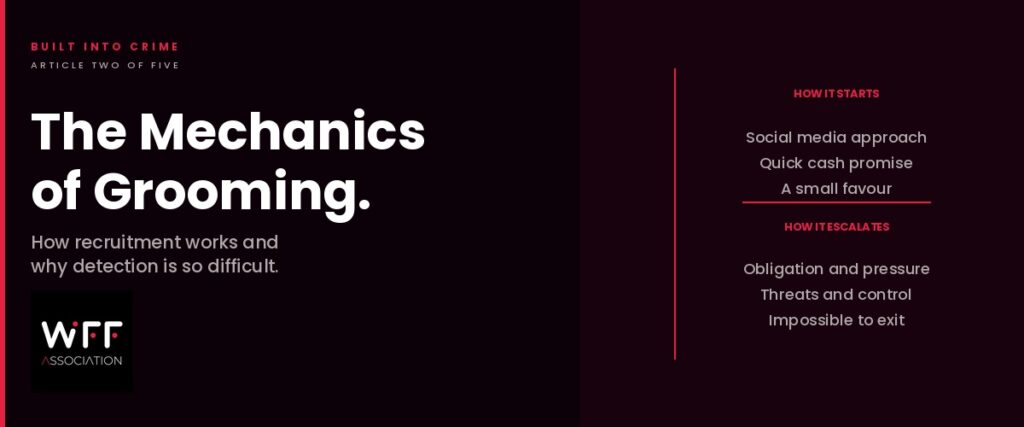
- Article Two: The mechanics of grooming and recruitment
- Article Three: Where the system is failing and inadvertently making things worse
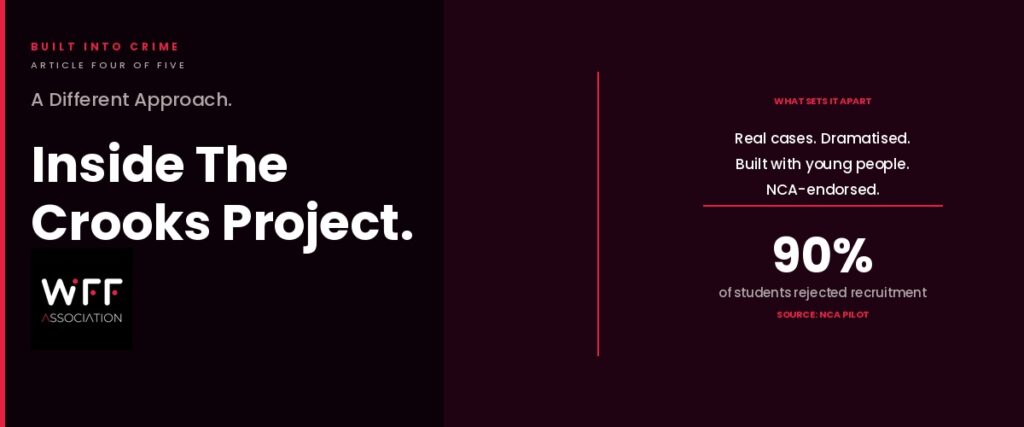
- Article Four: A different approach: The Crooks Project
- Article Five: What the anti-financial crime community must do now
The We Fight Fincrime Association (WFFA) brings together practitioners, organisations, and experts working across the full spectrum of anti-financial crime activity. To access expert insight, peer networks, and specialist content like this series, become a WFFA member today.



Responses