
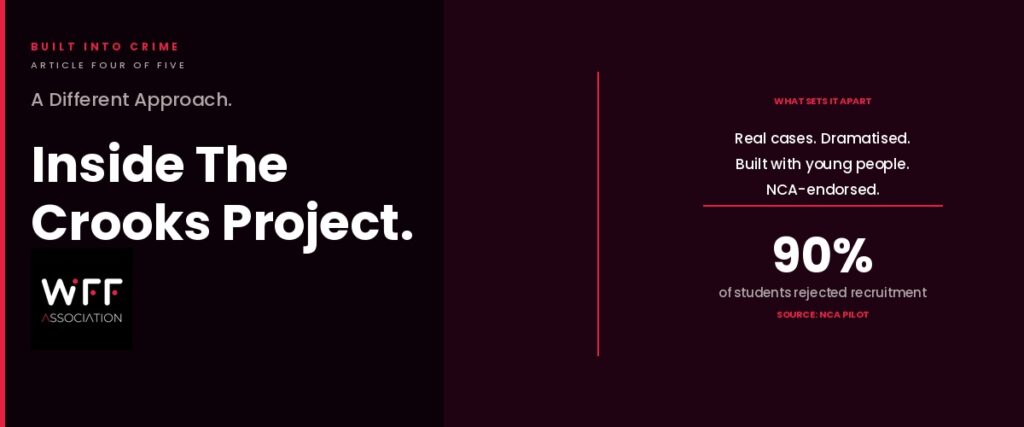
A Different Approach: Inside The Crooks Project

Against the backdrop of a system struggling to keep pace with the scale and sophistication of youth financial exploitation, a different kind of intervention has emerged.
The Crooks Project does not operate at the level of policy or prosecution. It operates at the level of understanding, which is, arguably, where the problem most urgently needs to be addressed.
Why traditional awareness approaches are not working
The dominant model for addressing youth financial crime awareness has, for years, been the “don’t do it” campaign: posters in schools, warnings in student handbooks, factual briefings about the legal consequences of financial exploitation. These interventions are not without value. But they have not moved the needle.
More than one-fifth of adults in the UK believe financial exploitation of this kind is legal. That figure, drawn from Cifas research, reflects not just a lack of information but a failure of communication. Facts, presented abstractly to young people who are being offered something concrete and immediate, do not compete effectively with a recruiter who speaks their language, inhabits their platforms, and frames exploitation as opportunity.
The Crooks Project starts from a fundamentally different premise: that young people do not need more warnings. They need to see the system for what it is, from the inside, before they are pulled into it.
What The Crooks Project does
The Crooks Project transforms real crime cases into short docudrama episodes, developed with young people themselves so that the scenarios reflect experiences they can genuinely recognise. The approach is built on the insight that lived experience, or a dramatised version of it that feels authentic, lands differently from a lecture.
Two programmes sit within the project.
Crooks on Campus targets university and international students, a cohort that is particularly exposed to financial exploitation. Many are managing money independently for the first time, navigating unfamiliar social environments, and under real financial pressure. All students are potential targets for criminals, but different types of students may be targeted for different types of financial crime. International students face specific risks, and the programme reflects this by following the story of an international student targeted by criminals when she seeks help paying her fees, alongside a home student, to show how different populations are approached in culturally specific ways.
Originally piloted with the National Crime Agency, the programme produced significant awareness and behavioural change among the student population, with 90% of students rejecting financial exploitation recruitment messages. The project also incorporates training for university staff and student representatives sharing information on campus. Alongside the drama itself, universities can access a free toolkit and digital resources, making it straightforward to roll the programme out to students at a time and in a way that suits them. For anti-financial crime professionals, the significance of that toolkit should not be underestimated: it puts structured, evidence-based prevention directly into the hands of the institutions where recruitment is actively happening.
The programme shows, through drama grounded in real cases, how actions that appear harmless, such as letting someone use your bank account, moving money for someone you know, or accepting “work” that involves handling funds, connect directly to serious organised criminal activity. The NCA itself has endorsed the approach, noting that Crooks on Campus can help warn students about financial exploitation recruiters that are known to target student populations, particularly among international students.
Rookie Crooks brings the same approach to younger audiences, addressing online exploitation, scams, peer pressure, and recruitment by organised crime groups in language and scenarios that school-age children can engage with. The programme is designed for the window that the NCA identifies as critical, the 11 to 16 age range when awareness-building is most protective, and translates complex financial crime concepts into relatable situations without oversimplifying them.
Why the approach is operationally significant
For anti-financial crime practitioners, the value of The Crooks Project extends beyond education. The initiative is also building an evidence base.
By working with young people directly, including those with lived experience of exploitation, it is developing a research-informed, qualitative understanding of how exploitation actually operates. This is not data that can be extracted from the National Fraud Database or law enforcement records. It is the kind of granular, human insight that shapes better detection frameworks, more effective intervention strategies, and more nuanced policy.
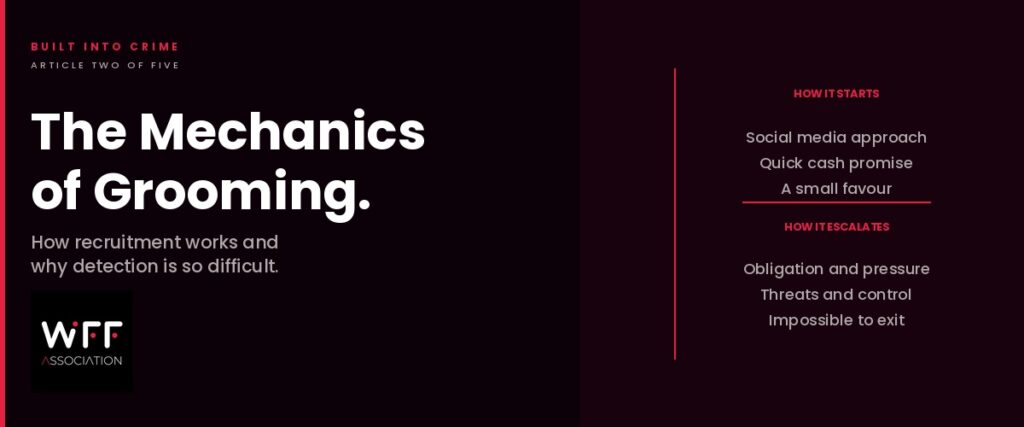
The connection to practitioner work is direct. Understanding why a young person did not recognise they were being groomed, what the recruiter said, how the ask was framed, and at what point the situation became impossible to exit, is information that can inform how compliance teams interpret anomalous account behaviour, how customer-facing staff are trained to respond to vulnerability indicators, and how safeguarding protocols in banks are designed.
Filling a gap the profession has identified
The Government’s 2026 Financial Exploitation Action Plan explicitly calls for tools and resources that reflect the lived realities of young people’s experience. Materials need to be targeted for different audiences and delivered through mechanisms that will maximise their impact. The Crooks Project is one of the very few initiatives currently designed and tested to do exactly that.
It also addresses something that the profession’s own data cannot: the cases that never reach a report, the young people who are exploited but never identified because they move small enough amounts, quickly enough, and exit before any flag is triggered. The invisible layer beneath the statistics.
Find out more about The Crooks Project at thecrooksproject.org and sign up for your free membership here.
Join the WFFA community of professionals working to build a more connected, informed, and effective response to financial crime. Become a member here.


Responses